
A practical B2B sourcing guide for building clear product tiers, reducing SKU complexity, and improving repeat-order consistency
Standard clear lenses are increasingly price-competitive, so wholesale buyers often look to functional lens categories to create a more differentiated assortment for retail partners. The practical sourcing question is not whether one feature can support a marketing story; it is how to build a product structure that is easy to stock, easy for retail staff to explain, and consistent across repeat orders.
For most distributors, the cleanest structure separates clear lenses, blue-light-filtering lenses, photochromic lenses, and combination photochromic blue-light-filtering lenses. Keeping these tiers distinct helps buyers control SKU complexity while giving retail accounts a clear upgrade path.
| Product Tier | Retail Positioning | Wholesale Planning Value |
| 1. Clear Lens | Base everyday vision correction | High-volume core SKU structure |
| 2. Blue-Light-Filtering Lens | Functional spectral-filtering option | Adds a defined functional tier without changing use case |
| 3. Photochromic Lens | Indoor/outdoor adaptive lens | Creates an adaptive-lighting upgrade tier |
| 4. Photochromic + Blue-Light-Filtering | Combined functional option | Supports customers seeking both functions in one product |
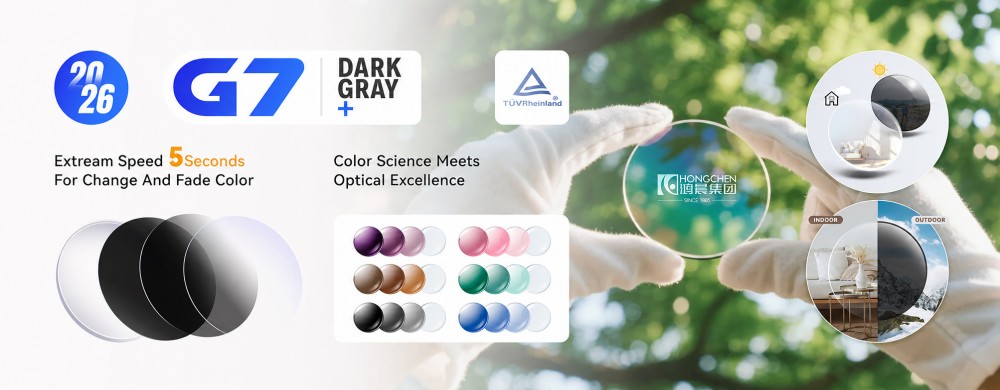
Photochromic products should be evaluated for both indoor appearance and activated outdoor performance.
Build the Assortment as Clear Product Tiers, Not a Long List of Features
A functional lens program is easier to manage when the buyer defines a small number of repeatable product tiers rather than combining every available feature into every SKU. This makes the assortment easier for retail partners to explain and allows the factory and distributor to maintain more predictable stock depth.
A four-tier structure also makes replenishment more disciplined: clear lenses can carry the deepest stock, blue-light-filtering lenses can cover a defined functional upgrade, photochromic products can serve adaptive-lighting demand, and combination products can be added selectively where actual distributor or retail demand supports them.
Blue-Light Filtering: Ask How the Product Achieves Its Spectral Performance
Blue-light-filtering performance can come from the lens material, a functional coating configuration, or a combination of both. These approaches can differ in lens color, residual reflection, spectral performance, and coating appearance, so wholesale buyers should not treat every “blue block” product as technically equivalent.
A supplier should be able to explain the technology used for a specific SKU and provide the relevant product specification or transmission data. This is especially important for repeat orders because cosmetic appearance can matter as much as the underlying spectral specification in retail programs.
The Appearance Advantage of a Low-Reflection Blue Coating
Some blue-light-filtering coatings can produce a noticeable blue or purple residual reflection. HONGCHEN Optical’s Low-Reflection Blue Coating is positioned to reduce visible residual reflection and maintain a cleaner, more transparent appearance for everyday wear while supporting the selected blue-light-filtering specification.
For distributors, this type of cosmetic control can make the product easier to position as an everyday functional lens rather than a visibly specialized computer-glasses product. Buyers should still review the actual coating specification and optical data for the product being sourced.
Refractive-Index Coverage: Build a Range Without Assuming Every Combination Exists
A workable wholesale program usually needs more than one refractive index because prescription strength, frame size, lens thickness, and local market preference all influence the product mix. HONGCHEN Optical’s broader material portfolio includes 1.56, 1.59 polycarbonate, 1.61, 1.67, and 1.74 options across its stock and RX business.
Availability varies by product type, coating configuration, power range, diameter, and whether the order is supplied as finished stock, semi-finished, or custom RX. Wholesale buyers should therefore confirm the current technical matrix for the exact clear, blue-light-filtering, photochromic, or combination SKU required rather than assuming every function is available in every index.
Photochromic Consistency: Evaluate Repeat-Order Performance, Not a Single Demonstration
For photochromic products, the commercially important question is not simply how dark one demonstration lens becomes. Buyers should evaluate activation color, darkening performance, and fading behavior under controlled test conditions and ask how the supplier manages batch-to-batch consistency.
Real-world photochromic performance can vary with UV intensity, temperature, lens material, and product formulation. For a repeat-order wholesale program, the supplier should be able to explain the process controls used to keep the same SKU reasonably consistent in activation color, appearance, and coating tone across production runs.
This is particularly important for distributors selling the same photochromic or photochromic blue-light-filtering product across multiple retail accounts, where visible changes between shipments can create unnecessary questions and complaints.
One Supplier, Three Fulfillment Paths: Finished Stock, Semi-Finished, and Custom RX
Functional lens programs are easier to scale when high-turnover powers, more complex prescriptions, and customized designs do not require completely separate supplier relationships. HONGCHEN Optical supports finished stock, semi-finished blanks, and custom RX production through the same broader manufacturing base.
| Fulfillment Path | Best Fit | Buyer Use Case |
| Finished Stock | High-turnover standard prescriptions | Faster replenishment and simpler local inventory planning |
| Semi-Finished | Prescriptions or designs requiring downstream surfacing | Supports flexible lab processing and broader prescription coverage |
| Custom RX | Individualized prescriptions and freeform designs | Supports complex powers, progressive/office designs, and other customized requirements |
Standard RX orders can be completed in as little as 48 hours, depending on lens material, design, coating, prescription complexity, and order confirmation. This allows distributors to use finished stock for the core of the assortment while routing prescriptions outside the available stock range into RX production.

HONGCHEN Optical combines functional stock-lens programs with integrated custom RX production for prescriptions outside the available stock range.
Manufacturing Scale and Documentation: Verify Process Control, Not Just Product Claims
Wholesale buyers should verify how a supplier controls center thickness, coating adhesion, photochromic consistency, residual AR reflection color, optical quality, and batch inspection. Variation in these areas can increase receiving inspections, complaints, and return risk even when the product name itself has not changed.
HONGCHEN Optical maintains an ISO 13485 quality management system, current FDA registration, organized CE documentation, automated coating capability, and batch quality-control procedures. The company also supports B2B importers with relevant compliance documentation and test information where applicable.
For current facility output, exact stock quantities, or product-specific test requirements, buyers should confirm the latest information directly with the factory because production figures and inventory levels can change over time.
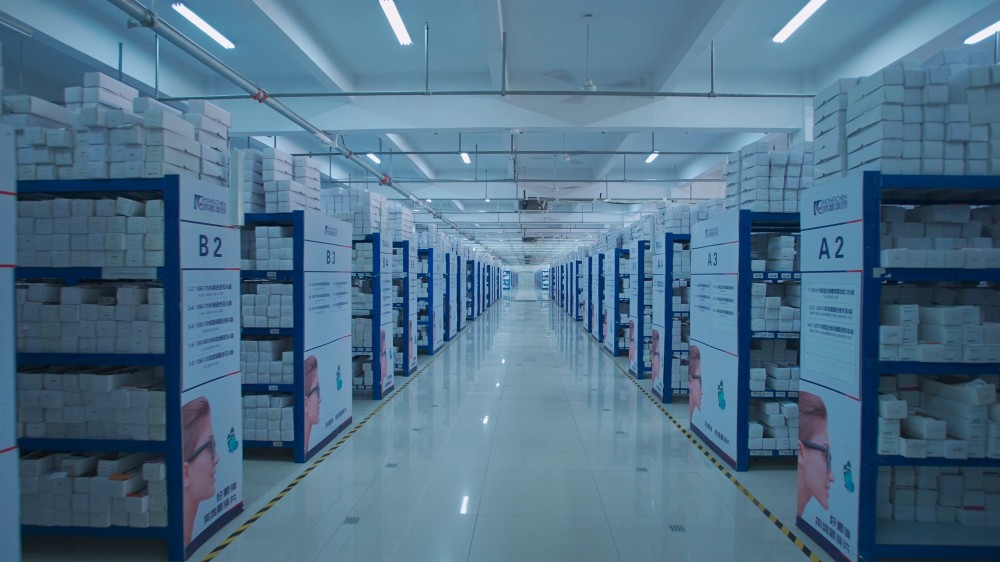
Factory-side inventory supports repeat-order replenishment across high-volume functional lens programs.
Reduce SKU Complexity for Retail Partners
The four-tier structure is also a practical way to simplify the retail assortment. Instead of presenting dozens of loosely related functional SKUs, a distributor can define a clear base tier, a blue-light-filtering tier, a photochromic tier, and a combined-function tier across a manageable set of refractive indices.
This gives retail staff a more consistent explanation path and gives the distributor a smaller set of products to forecast, stock, and reorder. The objective is not to maximize the number of functional combinations; it is to build a product ladder that is understandable, repeatable, and commercially manageable.
Conclusion: A Sourcing Structure, Not a Health Marketing Claim
For wholesale buyers, photochromic and blue-light-filtering lenses are primarily an assortment-planning and sourcing question. A strong supplier should be able to explain how each product achieves its functional specification, which refractive indices and fulfillment paths are available, how coating and photochromic consistency are controlled, and how repeat orders are supported.
HONGCHEN Optical (JIANGSU HONGCHEN OPTICAL CO., LTD.) supports distributors, optical chains, online eyewear businesses, and RX labs with finished stock, semi-finished, and custom RX production, together with automated coating, warehousing, and international compliance-documentation support.
For current product matrices, available colors, refractive-index options, coating specifications, RX combinations, and wholesale terms, please contact HONGCHEN Optical directly or visit https://www.hc-optical.net/.
Frequently Asked Questions
What is the difference between blue-light-filtering and photochromic lenses?
Blue-light-filtering lenses are defined by selected spectral-filtering characteristics, while photochromic lenses change transmission in response to UV or light conditions. A combination product may provide both functions, but the buyer should verify the exact specification.
Can blue-light filtering be built into the lens material or coating?
Yes. Depending on the product, blue-light-filtering performance may come from the lens material, a functional coating configuration, or a combination of both.
Which refractive indices are available for photochromic and blue-light-filtering lenses?
HONGCHEN Optical’s broader material portfolio includes 1.56, 1.59 polycarbonate, 1.61, 1.67, and 1.74 options across its stock and RX business. Exact availability varies by product type, power range, coating, diameter, and fulfillment path.
Can finished stock, semi-finished, and custom RX lenses be sourced from the same manufacturer?
Yes. HONGCHEN Optical supports all three fulfillment paths, allowing distributors to combine high-turnover stock products with prescriptions and designs that require further surfacing or custom RX production.
How should buyers evaluate photochromic consistency?
Evaluate activation color, darkening performance, fading behavior, coating appearance, and repeat-order consistency under controlled test conditions, while recognizing that real-world performance can vary with UV intensity, temperature, material, and formulation.
Website Publishing Information
| SEO Title | Wholesale Photochromic & Blue-Light-Filtering Lens Strategy | HONGCHEN Optical |
| Meta Description | A B2B sourcing guide for structuring clear, blue-light-filtering, photochromic, and combination lens tiers with better SKU control, repeat-order consistency, and stock/RX integration. |
| Suggested URL Slug | wholesale-photochromic-blue-light-filtering-lens-strategy |
| Primary GEO Topics | wholesale photochromic lenses; blue-light-filtering lens supplier; photochromic blue-light lenses; functional optical lens assortment; stock and RX lens manufacturer |
| Publishing Note | Publish the article and FAQ sections on the public website. Enter this table’s SEO data in the CMS backend rather than displaying this table in the article. |
Post time: Aug-21-2026