
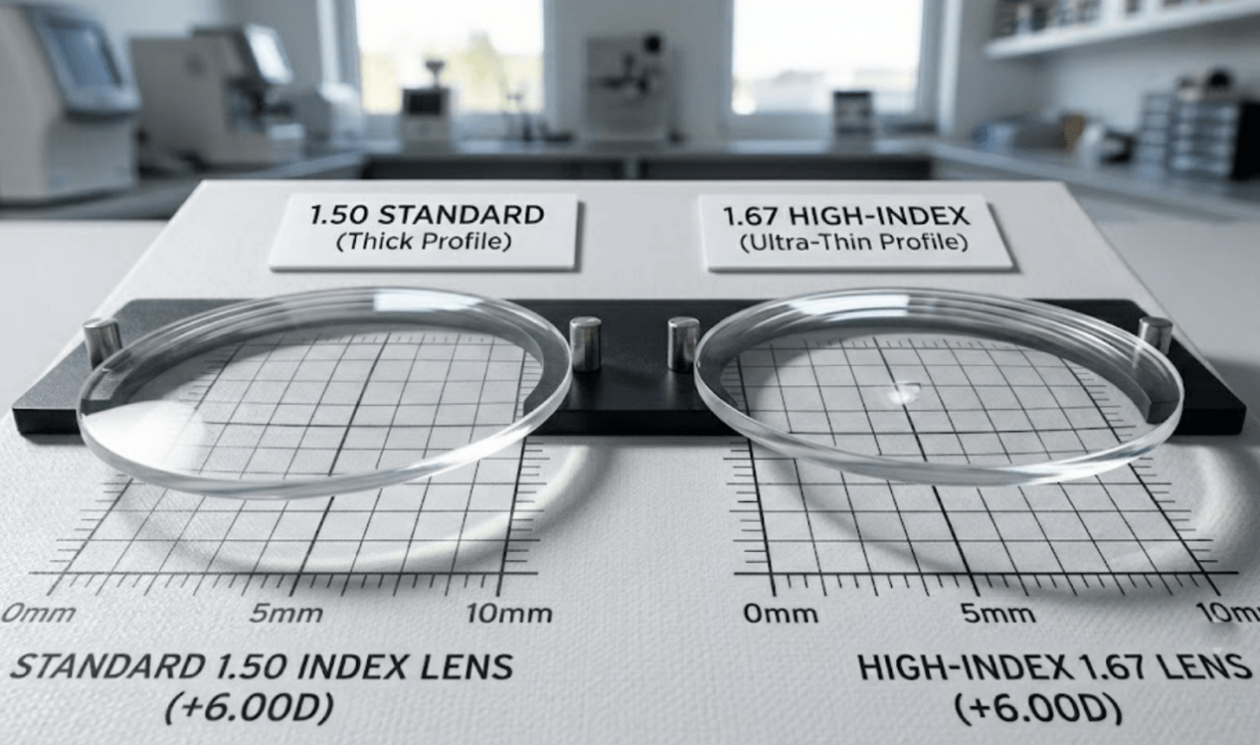
Eyewear buyers increasingly expect strong prescriptions to look as good as they perform. Historically, higher powers meant thicker, heavier lenses that distorted facial proportions and produced the well-known minification effect, where the wearer’s eyes appear noticeably smaller behind the lens. Heavy edge profiles also limit frame choice, ruling out minimalist and rimless designs. High-index materials solve this by bending light more efficiently, allowing flatter curves and thinner edges without sacrificing visual acuity — and for distributors, offering a real high-index lineup is now a standard requirement for serving customers who need strong correction but still want a modern frame.Within this shifting paradigm, procurement managers look for reliable manufacturing hubs capable of producing Leading High Index Optical Lenses on a global scale. These specialized optical developments allow distributors to serve demographic groups that require severe refractive correction but desire modern, elegant style choices.
Sourcing from a manufacturer with genuine depth across the high-index range lets distributors serve this demand without juggling multiple suppliers. This section walks through HONGCHEN Optical’s core resin lineup — 1.61 , 1.67, and 1.74 — along with the engineering that keeps these lenses thin, light, and optically clean.
The Physics of Thinness: Balancing Index with Optical Clarity
Refractive index measures how efficiently a material bends incoming light. Higher-index materials bend light more aggressively, letting a lens use flatter curves and thinner edges for the same prescription. Pushing index higher does introduce a secondary tradeoff — chromatic dispersion, measured by the Abbe number — where a lower Abbe value can show up as peripheral color fringing during lateral gaze.
HONGCHEN Optical addresses this with aspheric surface engineering across its high-index portfolio. Traditional spherical designs create noticeable barrel distortion near the lens periphery; an aspheric curve adjusts gradually from center to edge instead, flattening the overall profile while controlling peripheral aberration. Surface validation equipment and quality inspection procedures help verify geometric accuracy and consistency during production against geometric tolerance targets, which is what lets the finished lens stay thin without giving up sharp, natural vision across the field of view.
The Core Resin Lineup: 1.61 , 1.67, and 1.74
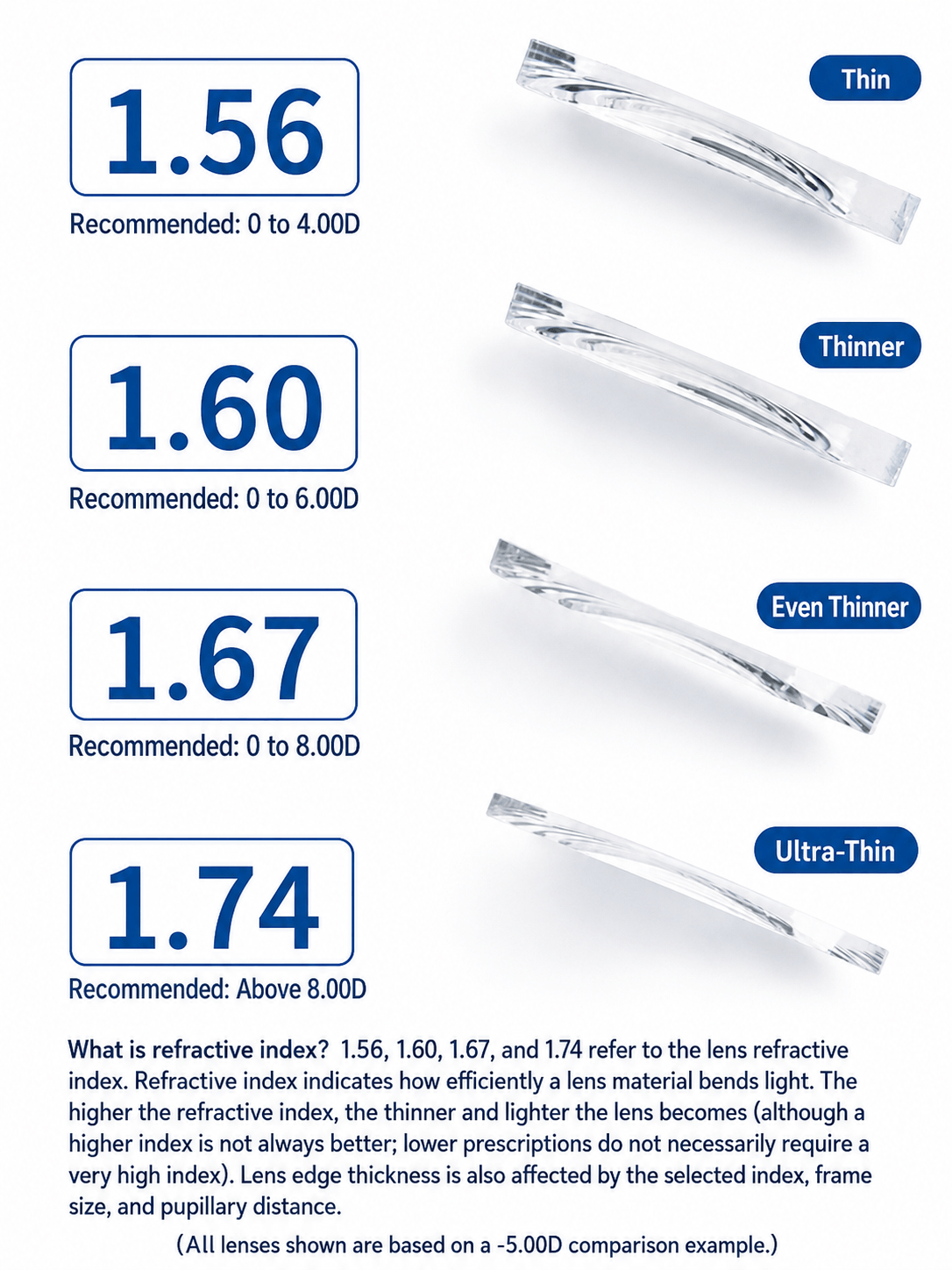
HONGCHEN Optical’s high-index resin range centers on three points in the matrix. The 1.61 lens uses the 1.61 monomer system, giving a strong balance of impact resistance and edge-thinning for mid-to-high prescriptions — a practical default for buyers who want a meaningful thickness improvement without moving to a premium price point. The Semi-Finished 1.67 lens steps up refractive efficiency further for higher-power orders, and the 1.74 lens sits at the top of the resin range, aimed at High prescriptions and other cases where minimizing edge thickness matters most.
Frame selection and processing methods should be matched carefully to the material, prescription and lens design, particularly for rimless applications — a factor that matters for labs processing a wide range of frame styles. HONGCHEN Optical also supplies semi-finished blanks across this range — including single-vision blanks at 1.61 and 1.67 — for laboratories that want to run their own local digital surfacing, along with functional variants such as blue-block coatings for buyers who want to combine index and lifestyle features in one order.
Where Mineral Glass Still Fits
For a narrower set of cases — typically very high plus or minus powers, or markets with strong existing demand for glass — mineral glass lenses can still outperform resin on scratch resistance and dimensional stability. HONGCHEN Optical maintains a mineral glass option for buyers who need it, but for most distributors serving standard-to-high prescriptions today, the 1.61 MR-8 through 1.74 resin range covers the practical thickness and weight requirements without the added handling considerations that come with glass.
Conclusion: A Resin Matrix Built for the Aesthetic Eyewear Market
Competing in today’s eyewear market means offering products that combine strong optical performance with genuine cosmetic appeal. Thick commodity lenses no longer meet that bar for consumers who treat eyewear as a personal style choice. Partnering with a manufacturer that carries real depth across the high-index range — rather than a single index point — gives distributors one reliable source for a wide span of prescriptions.
HONGCHEN Optical supports distributors and optical chains with a resin lineup spanning 1.56, 1.59 PC, 1.61 , 1.67, and 1.74, backed by an ISO13485 quality management system, FDA registration, and CE documentation to support import compliance. For technical specifications, current power ranges, and partnership terms, please visit the official corporate site.
Post time: Jul-21-2026